

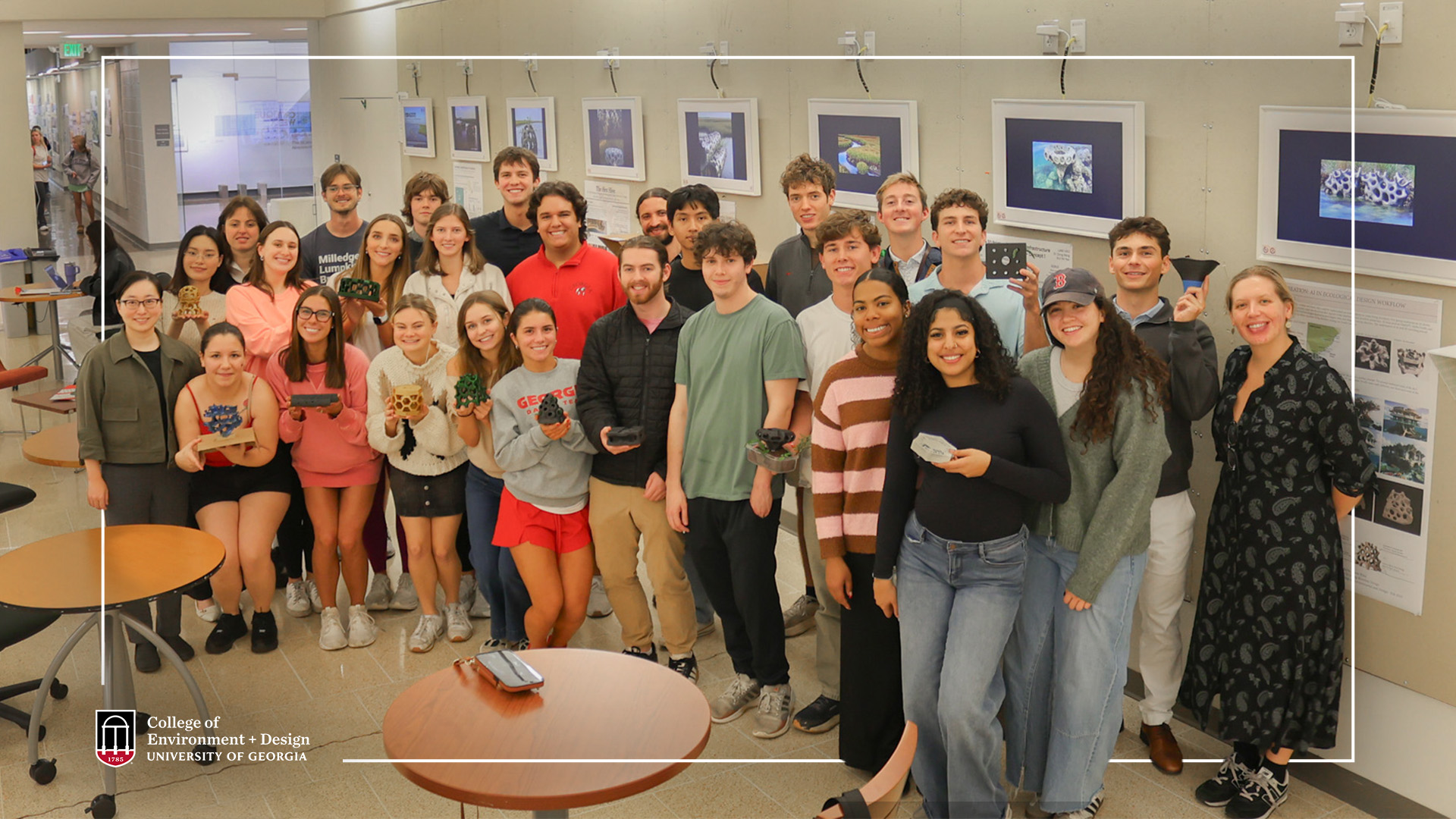
Third-year Bachelor of Landscape Architecture (BLA) students at the University of Georgia’s College of Environment and Design (CED) are redefining coastal protection. In the LAND 4360 Advanced Landscape Ecology course, led by Dr. Qiong Wang, students recently completed an innovative project titled “AI + 3D Printing for Adaptive Infrastructure in Living Shoreline Design.”
Coastal areas currently face intensifying threats from erosion, flooding, and storm surges. To address these challenges, students explored the potential of living shorelines, resilient, adaptive infrastructure supported by nature-based solutions.
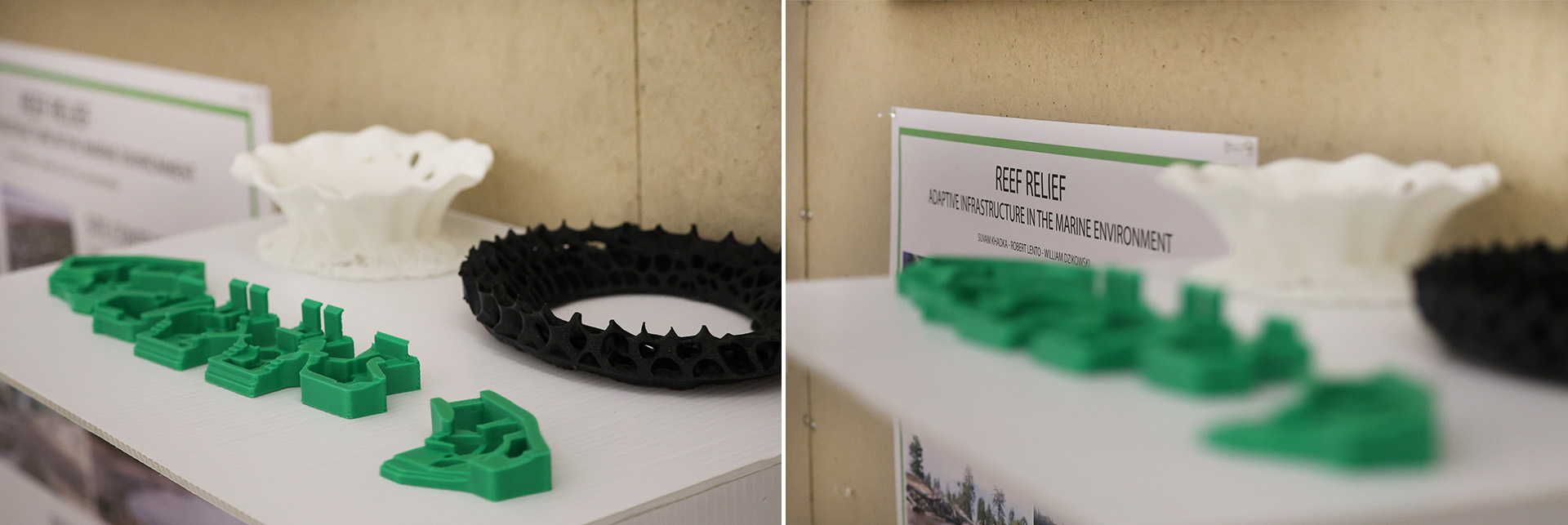
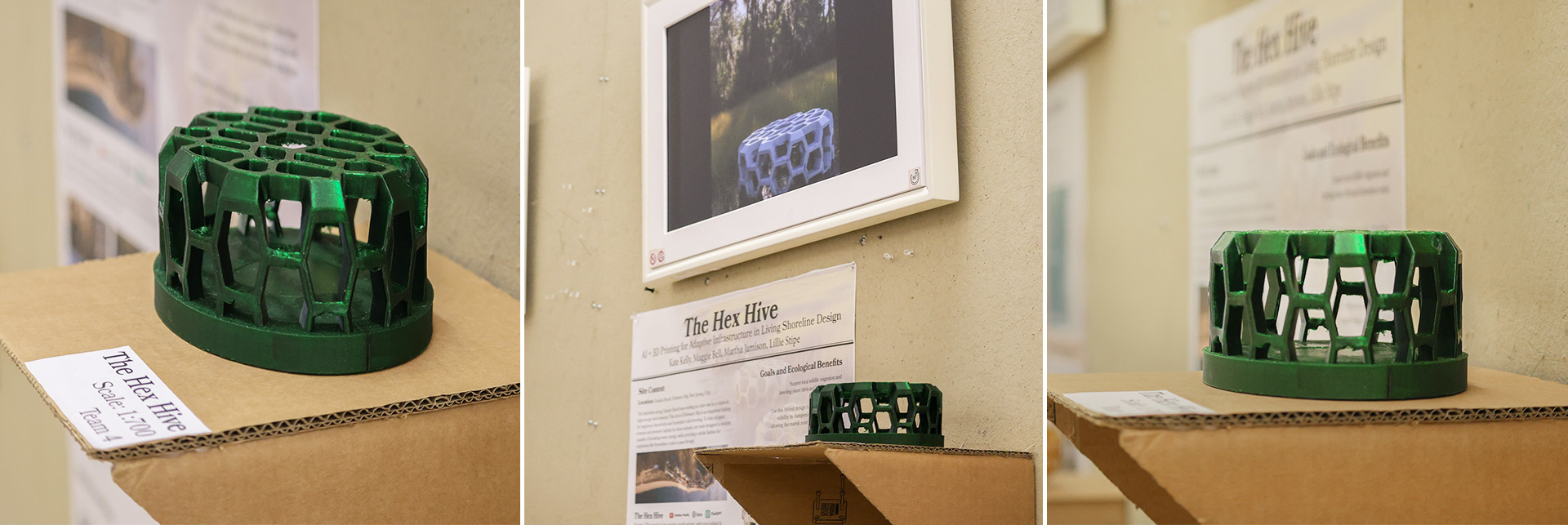
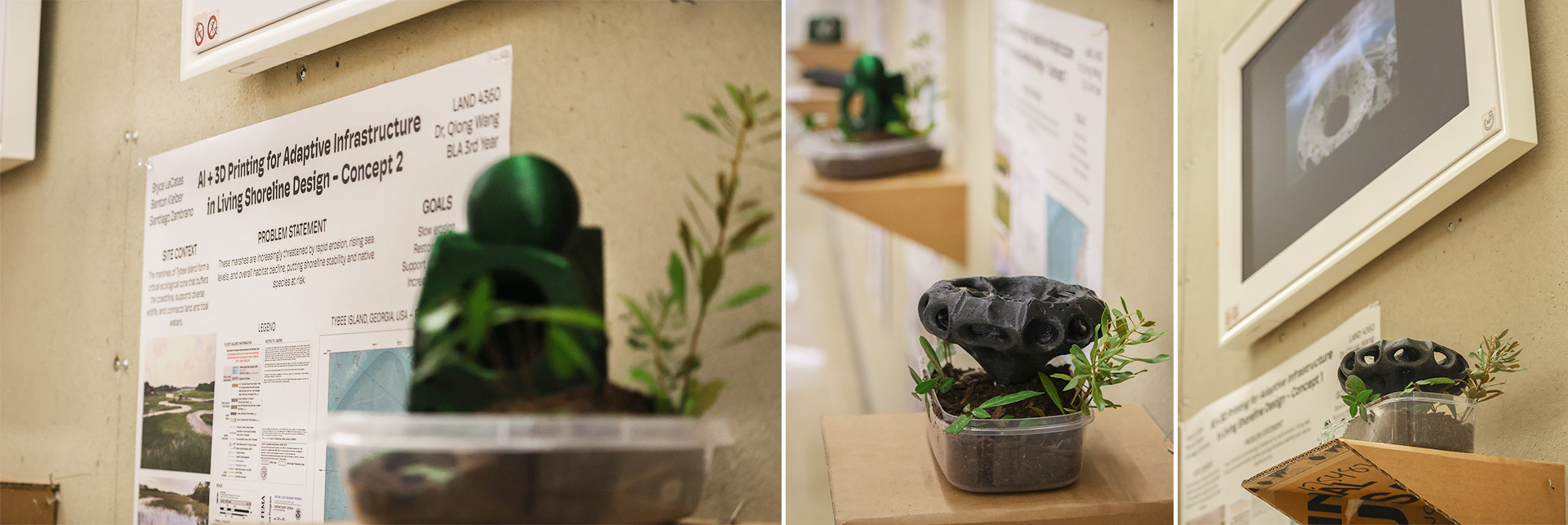
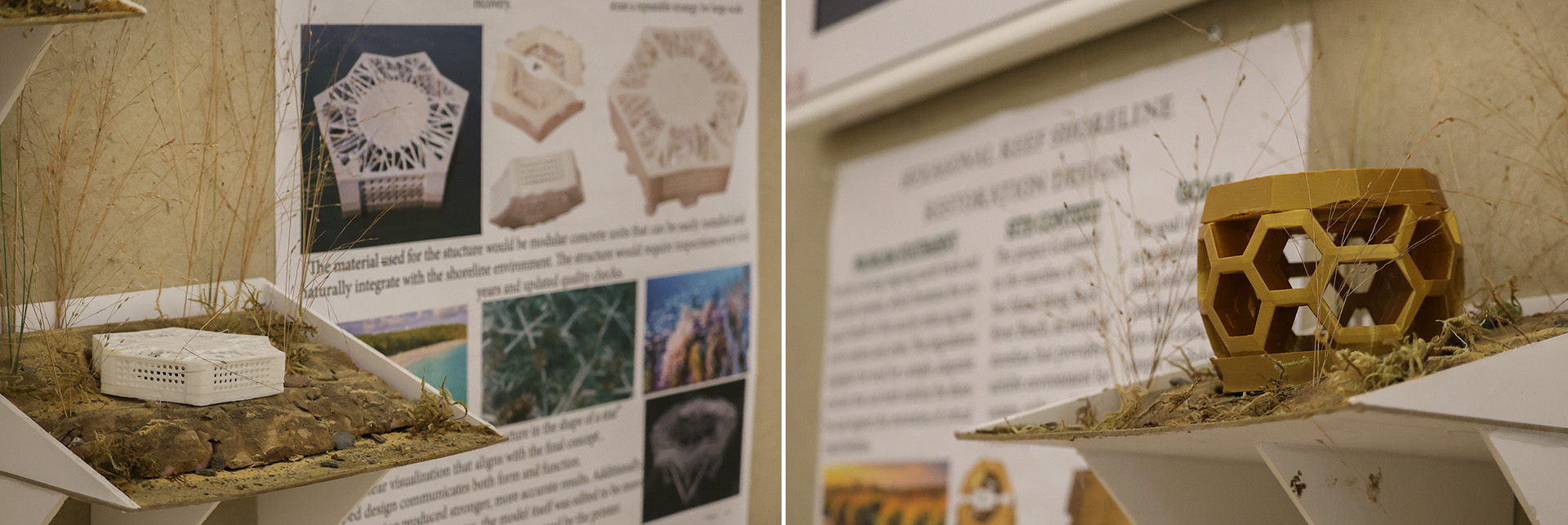
The project challenged students to move beyond traditional methods by integrating Artificial Intelligence (AI) tools and 3D printing into their design process. The AI-assisted design workflow required students to generate diverse design variations and translate digital concepts into physical, scaled models using 3D printers, while maintaining ecological performance goals. Their final proposals translate digital concepts into tangible models that communicate materiality, structure and spatial relationships.
“The projects are stunning, resulting in practical design solutions for shore stabilization, illustrative animations and 3D printed models,” said Associate Dean for Academic Programs and Student Affairs Ashley Steffens. “This work elevates student portfolios and demonstrates the future of technologically advanced design solutions for the built environment.”
On Nov. 20, students presented their final projects at an open house in the Jackson Street Building.
“One of Dr. Wang’s students was there in the hallway still taking in the work himself, and I asked him about the project and what he thought of it,” said Brad Davis, Associate Dean for Research and Faculty Affairs. “He went on for a solid thirty minutes about the project, its challenges, problem solving, and what he felt was his best learning experience to date in the program. No professor could ask for a better testimonial from a student.”
All are welcome to see students’ final work of posters, models and videos in throughout January in the Digital Pin-Up Space (119A), Jackson Street Building, 285 S. Jackson St., College of Environment and Design, University of Georgia.
“As dean of the college, I feel exceptionally privileged to have Dr. Wang on our faculty,” said CED Dean Sonia Hirt. “She has established herself as one of our most innovative instructors and her latest studio project is a testimony to her cutting-edge methods and outstanding command of the field.”
Our students enjoyed the course and reflected on their experiences and insights through hands-on learning, integrating advanced technologies into the design process. Take a look at some of the work below!
Robert Lento
“My interaction with AI has been limited until taking this class. Going through this process of using AI+3D printing was very eye-opening and exciting for the potential of future ideation with design proposals. Personally, regarding AI’s generation capabilities, I believe that the software is very useful and has a lot of benefits for the designer and customer, with limitations only being on the ability and determination of the designer that is running those systems. From this process and interaction with these systems my ability to combine creativity and technology for better ecological thinking has increased drastically.”
Kate Kelly
“I had heard of 3D printers but had never actually used one myself. I knew they existed and had seen videos online of people making things with them, but it was so different to see it in person… After learning how it works I can now see a lot of ways 3D printing could be used in landscape architecture. Having access to tools like this feels like it will make me a stronger and more flexible designer.”
Benton Kleiber
“The AI just helps speed up the steps between idea and prototype. I think it’s exciting that we can use tools like this to explore form faster than ever, but we still have to stay grounded in why we’re designing what we’re designing.”
Gianna Pacelli
“This course also changed how I view the future of landscape architecture. Before, I mostly saw AI as a creative shortcut. I do not think AI will ever replace the human designer, but I do believe it will become a normal and useful partner, especially for early ideation, environmental visualization, and communicating ideas.”
Acknowledgements
3D models were printed using the 3D printers at the Resilience Lab, supported by the UGA Center for Teaching and Learning Grant (Founder and Principal Investigator: Dr. Qiong Wang)
Special thanks to the Generative AI & Teaching (GAIT) Faculty Fellows program for its valuable support and encouragement throughout this class project. Thank you for your support and help, Ruth Poproski, PhD and Felicitas Hartung, PhD!
Thanks so much to our collaborators, Dr. Yao Wang (Louisiana State University) and Mr. Tyler Ortego, for delivering a guest lecture to our students.
Many thanks to Dr. Jon Calabria and Professor Cari Goetcheus for their generous support in establishing the Lab.
Thank you to my leaders, Dean Sonia Hirt, Associate Dean Ashley Steffens, Associate Dean Brad Davis, and BLA program director Donnie Longenecker for their support of our students’ innovative learning experience.
Thank you to our marketing and communications staff, Megan Dupre and Lanier Pickren Smith, for their help with photography and writing, as well as to other colleagues at the UGA College of Environment + Design for their continued support.


