

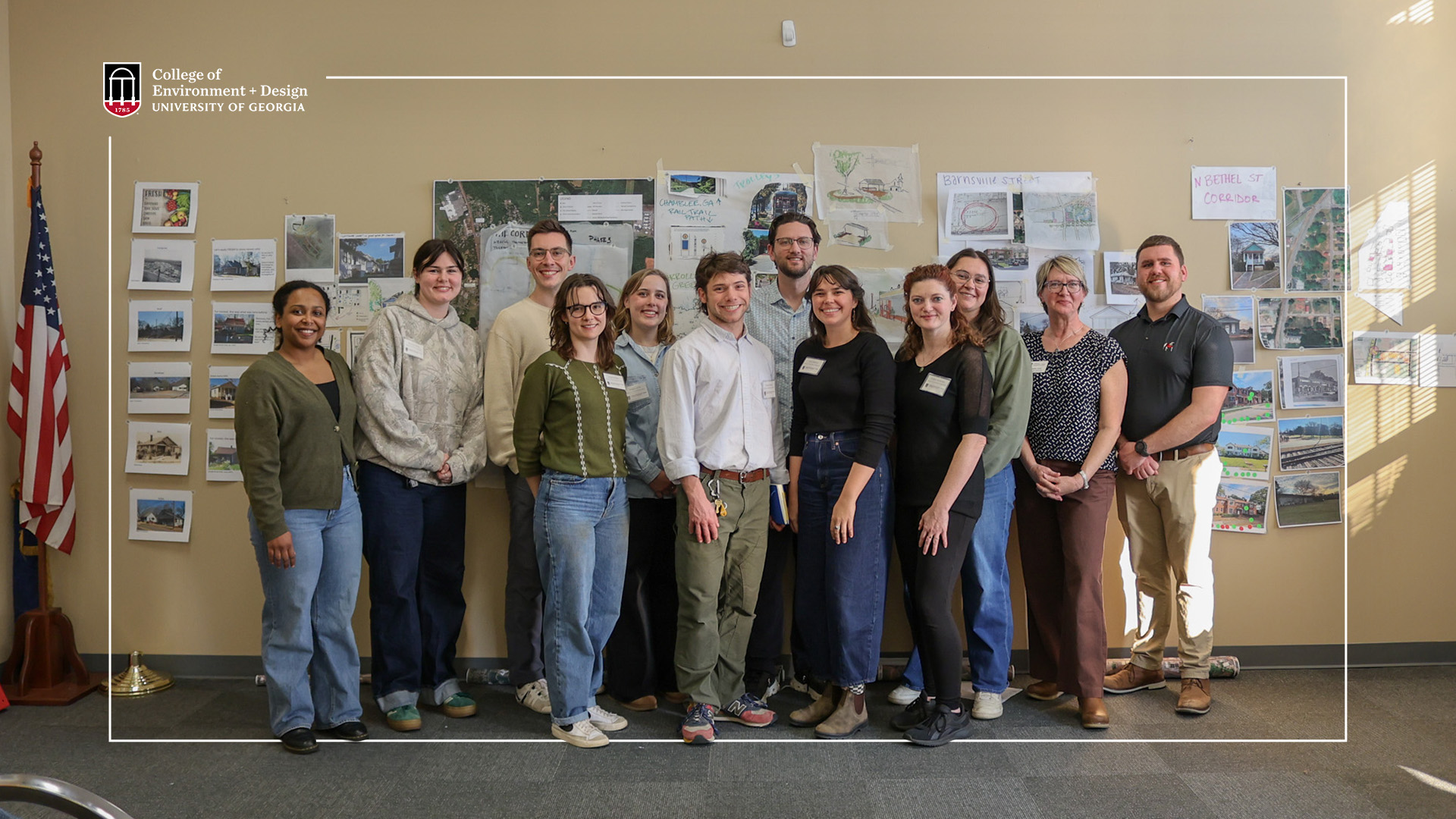
From Feb. 7 to 9, Master of Landscape Architecture and Master of Historic Preservation students at the College of Environment and Design teamed up to help the City of Thomaston redevelop, revitalize and reinvest in a historically underserved area.
On Feb.7, 2026, the Stone Well Worship Center in Thomaston, Georgia opened its doors to something slightly unusual for a typical Saturday: 10 graduate students from the University of Georgia, laden with maps, highlighters and curiosity.
As they set up tables with large-scale maps of Thomaston, members of the public trickled into the sanctuary and introductions began. Following a pizza lunch, the students joined community members around the table and started the work that brought them to the small middle Georgia town.
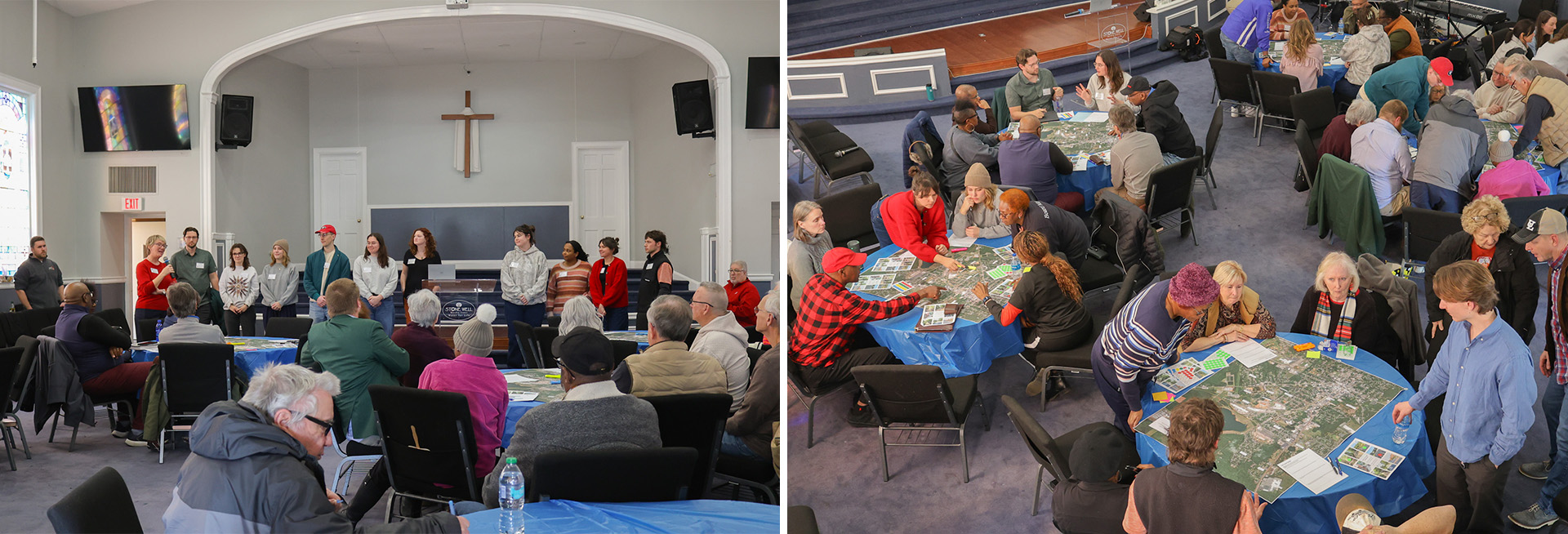
The CED charrette team is introduced to members of the Thomaston public at the Stone Well Worship Center at the first public input session of the week (left). Members of the public point out their likes, dislikes, desires and things they would like to see changed on large-scale maps of East Thomaston at the input session (right).
Mill Town to Master Plan
The group, a mix of six landscape architecture and four historic preservation students, spent three days in Thomaston as part of a design charrette led by the CED’s Center for Community Design and Preservation (CCDP). A design charrette is a rapid multi-day workshop in which a team of designers and local stakeholders focus on a particular planning problem and arrive at a solution together.
The goal of this charrette was to develop a conceptual master plan that envisioned a variety of attainable housing options and explored connectivity between community assets in the area of East Thomaston. The concepts created by the charrette team would become the foundation of the city’s East Thomaston Revitalization Plan.
The meeting at the worship center was the first step of the charrette weekend. Using maps of Thomaston to guide discussion, the charrette team asked the public about their likes, dislikes and desires for East Thomaston.
“We aren’t going to make you Atlanta,” said CCDP Director Jennifer Lewis to community members at the input session. “You want to look like Thomaston. You all have a rich history here. Our job is to take the lens of your culture and apply it to something that isn’t here yet.”
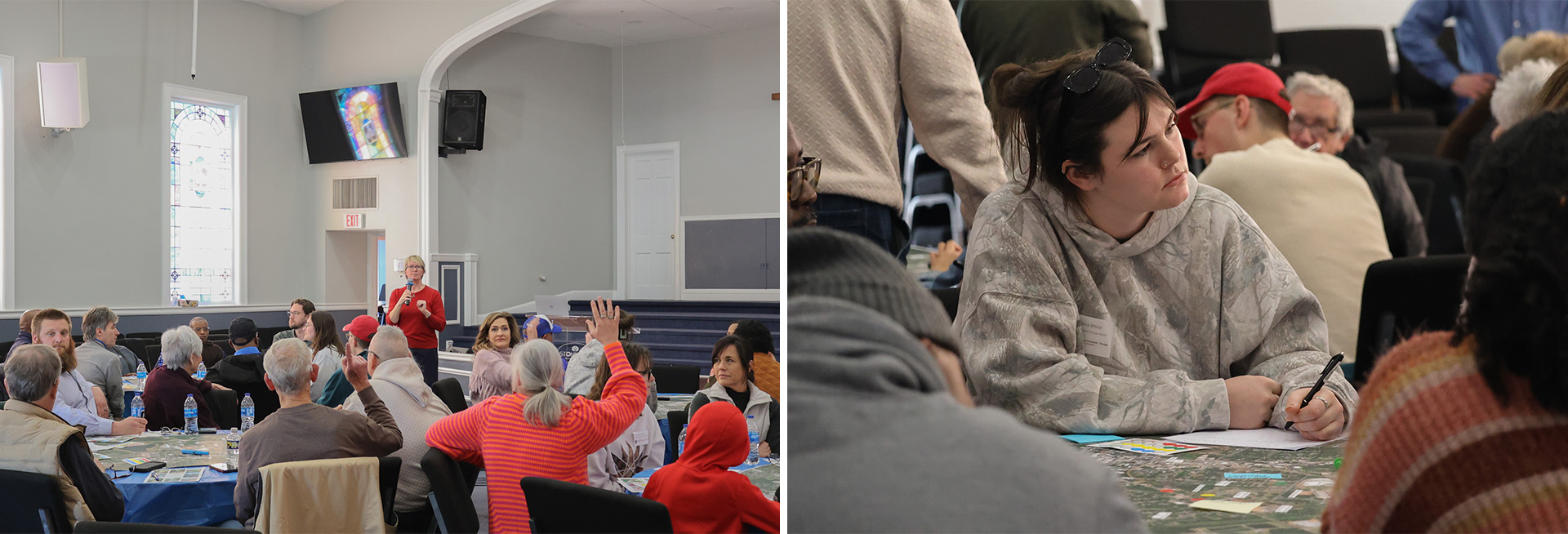
CCDP Jennifer Lewis explains the “Map Your Town” visioning exercise (left). MHP student McKenna White writes down feedback during the public visioning session.
Thomaston is a city of just under 10,000 people in Upson County, nestled between the larger cities of Macon and Columbus. A rich industrial history is the backbone of the community.
For nearly 200 years, cotton textile mills provided employment to much of the population. Thomaston Mills, started in 1899, built mill villages throughout the city that provided housing, churches, schools and other amenities for its employees. When Thomaston Mills shuttered in 2001, these structures remained, and areas like East Thomaston became negatively impacted by absentee landlords and blight from the vacant lots left behind by the mills.
Thomaston’s Economic Development Director and the charrette team’s host for the weekend, Taylor Smith, helped to identify key areas of need for the charrette team to address, which included infill housing, utilizing a defunct rail line and mixed-use development on existing lots.

Throughout the weekend, the charrette team toured different areas of Thomaston. Economic Development Director Taylor Smith shows students a house built using one of Thomaston’s infill housing plans (left). Students on a walking tour of East Thomaston (right).
These goals and history were in the back of the charrette team’s mind at the Stone Well Worship Center, the first of three meetings that the charrette team would have with stakeholders throughout the design process.
About 50 members of the public showed up to the input session, a group that spanned ages and backgrounds.
“It’s been neat watching people engage, cross-pollinate,” said John Shales, a local pastor who attended the session. “Sometimes when we’ve lived in a community so long, we can get tunnel vision.”
The youngest participant? Nine-year-old Lucas Austin, a lifelong resident and young historian who attended the session with his father, Nash Austin.
“I’m ready for them to save the buildings and get more business and bring back the abandoned buildings,” said Austin.
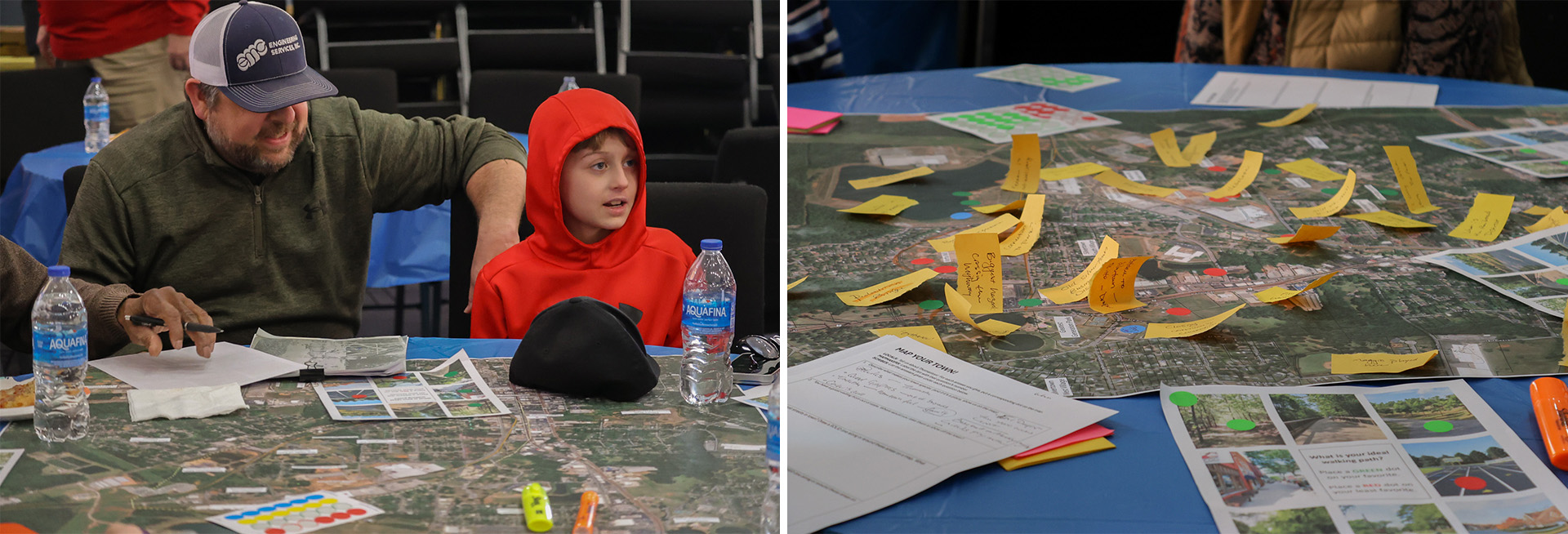
Lucas Austin and his father, Nash, at the public input session (left). Close-up of a map used in the input session activity, “Map Your Town,” where participants labeled likes, dislikes and desires for East Thomaston (right).
Design in Action
After the input session, the charrette team set out to draw up initial concepts for East Thomaston based on the community feedback.
Setting up shop in the Thomaston Senior Center, the group gathered around to discuss common threads in conversations they had with the public. One by one, Lewis called on the students to share a takeaway or need they identified during the session.
“They bring the expertise of being in the 18 to 30s age range that a lot of small towns lose and want to attract,” said Lewis of the charrette team. “They are coming in with fresh eyes and their experiences, and they do not have the baggage that someone from a community does who has seen things fail or ideas not materialize.”
After indexing the things they heard– a desire for more resources, access to resources beyond the area, a variety of residential and mixed-use developments and easy beautification– the group split into four teams to draw up initial concepts.

Jennifer Lewis records feedback heard at the Stone Well Worship Center during the charrette team’s meeting debrief (left). MLA student Noah Cleveland points at areas of interest in East Thomaston that arose during the public input session at Stone Well Worship Center (right).
One group looked at rail-trail options that would connect the different parcels around East Thomaston together and to the rest of the city. The other three groups chose to work in specific parcels of land in East Thomaston that were city-owned or for sale. Of these three groups, one group focused on small, affordable single-family housing options that were consistent with the historic character of the area.
“I’m really excited to be here at this charrette,” said Noah Cleveland, a third-year MLA student who worked on concepts for mixed-use development in a vacant lot. “It’s such a unique opportunity for us students, especially in the design context, just to come and get experience with designing and helping a community.”
While this was the first charrette experience for most students in the group, the CCDP has conducted over 100 charrettes since 1997. To the Center, the benefit of conducting facilitated charrettes is the flexibility to address the unique needs of each community in a focused setting.
Thomaston is no stranger to working with University of Georgia teams. In 2023, the CCDP conducted a mini-charrette in Thomaston’s downtown to assist owners seeking facade grant funds. As of 2025, five of the eight properties have made improvements, receiving $43,500 in grant funds for a total investment of $139,800.
“Thomaston is really becoming a showpiece in the state for how small towns can use preservation-sensitive ideas for good economic development and revitalization,” said Lewis. “I wanted to bring my students here so they could see how this was working well in the community and inspire them, which I think it has.”
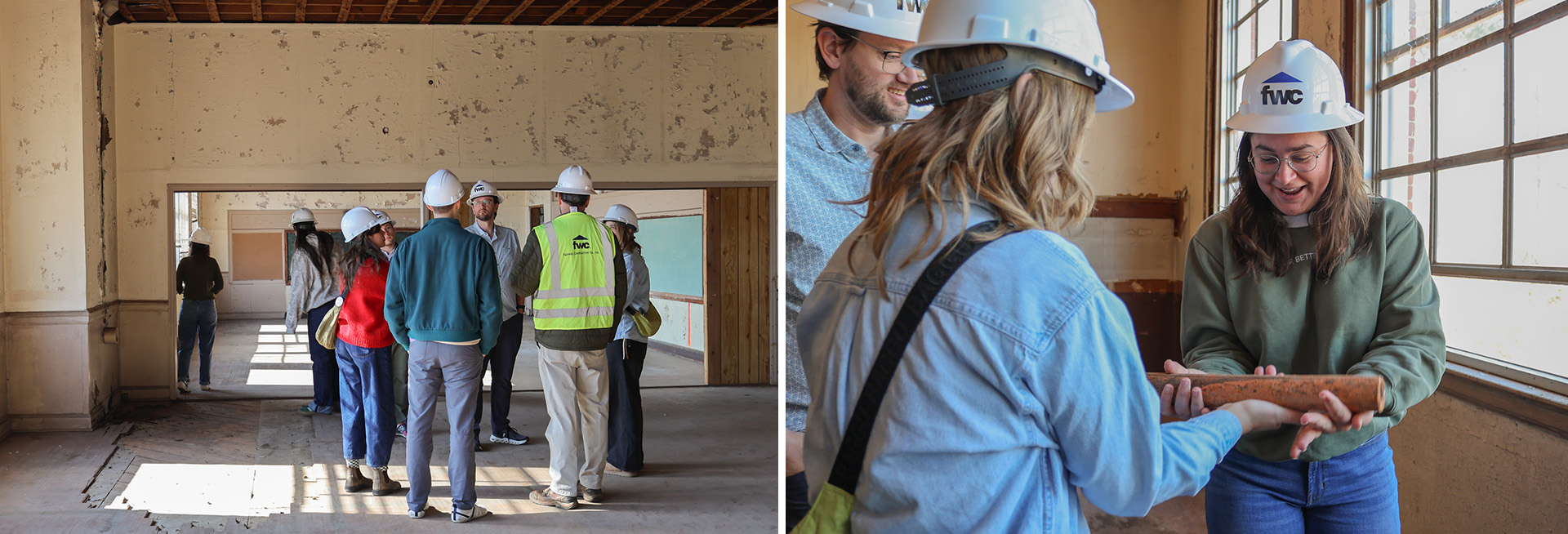
Over the weekend, the charrette team toured an adaptive reuse project of a historic school house in East Thomaston. The former school building will be repurposed into affordable senior living apartments. Students gather in a former classroom (left). MHP student Erika Wesch holds a sash weight from a window in the classroom (right).
Designing Impact
Just 24 hours after the input session, it was time to present initial concepts to the second group of stakeholders: Thomaston-Upson Georgia Initiative for Community Housing (GICH).
Throughout Sunday afternoon, GICH members went around to each of the four groups to view their concepts and offer feedback.
A strong sentiment that echoed at Saturday’s input session and again at the GICH meeting was a desire to recognize the cultural heritage of East Thomaston. Two main corridors that run through East Thomaston have a strong history of being Black-owned business hubs, and Thomaston’s African American Museum is in the neighborhood. Elevating the area’s culture was woven throughout the student’s ideas, which included museum expansion, entrepreneurial hubs and dignifying the neighborhood with a formal name befitting its history.
“First, I have to say thank you,” said Rhondalynn Traylor, a member of the GICH team in her introductions to the group. “Listen, you can say, ‘No’ 100 times. [You] are here because you change mindsets in Upson County. You gave us a voice to be able to connect whites and Blacks, and make everybody feel like they’re on the same playing field. You did that for us.”
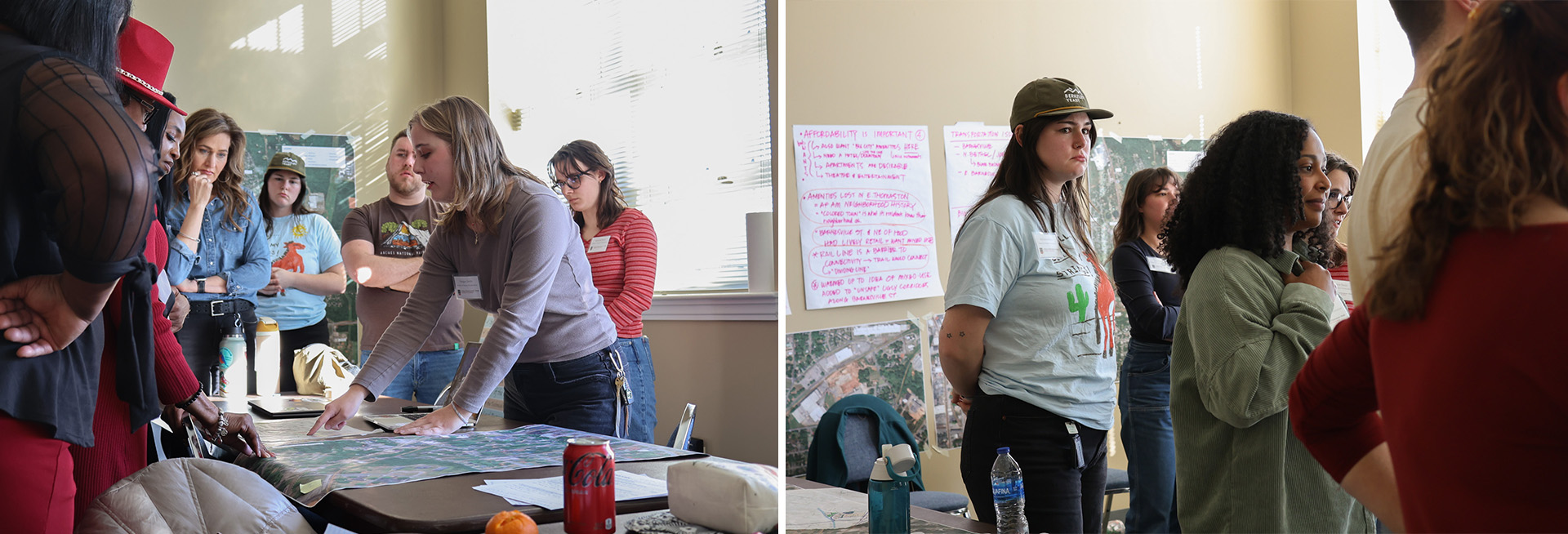
MHP student Reagan Smith presents concepts for affordable single-family housing options to members of the Thomaston-Upson GICH team (left). MHP student McKenna White tears up following remarks from GICH member Rhondalynn Traylor.
Though only the second meeting of the trip, the agency felt palpable.
“A lot of [plans] do tend to sit on the shelf until the next five-year update, and that just kind of breaks our hearts,” said Stephanie Wagner, a regional planner for the Three Rivers Regional Commission, to the charrette team. “These will be on the ground improvements that happen soon thanks to you all.”
After the meeting with the GICH committee wrapped up, it was time for the UGA team to burn the midnight oil and prepare their final concepts and recommendations for East Thomaston, with a brief break for the Superbowl LX halftime show.
On Monday afternoon, students presented their work to city and county officials, including Thomaston’s mayor and city manager.
“Today the idea is to bring in actual city and county staff, give some real thoughts and feedback on what is palatable, what could be, what could not be, what is going to get us run out of town, right?” said Smith to the representatives.
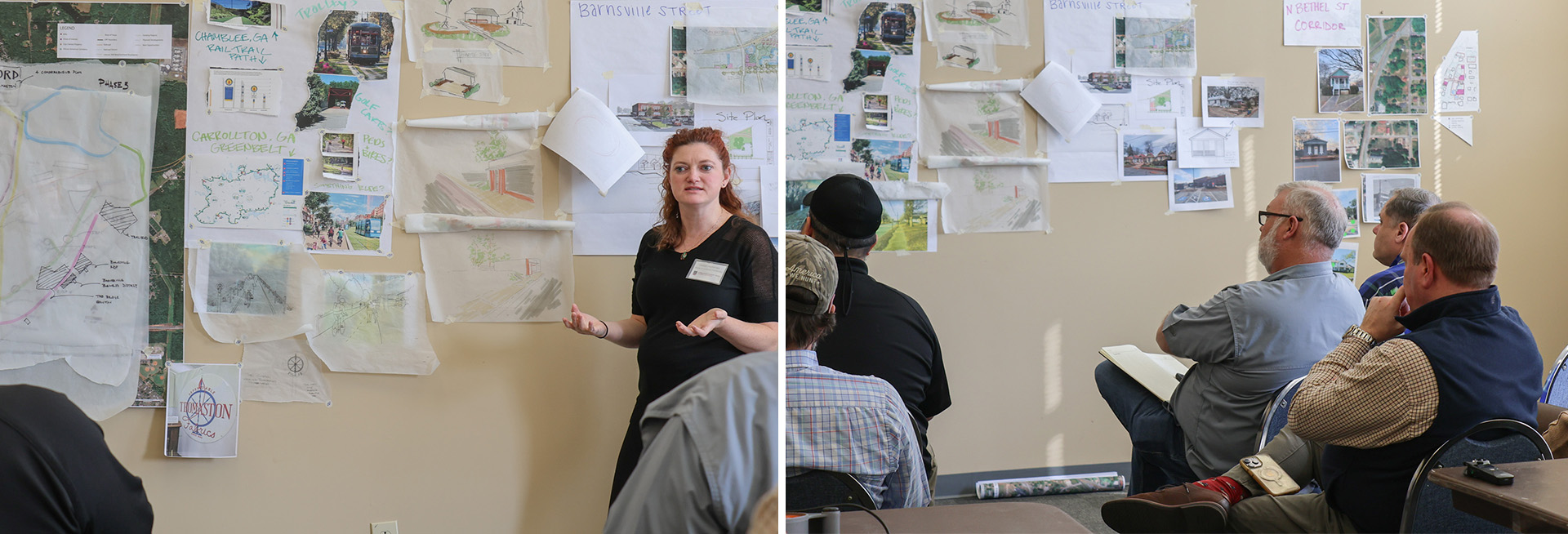
MLA student Caitlyn Hentenaar presents rail-trail concepts to city and county representatives (left). Thomaston representatives and officials watch final charrette weekend presentations (right).
“It is a fast-paced process,” said Lewis. “The printer is still running. We have marker all over our hands.”
One by one, each team presented their final design concepts to the group of officials.
Among the work presented was a recommendation for a trail system around East Thomaston named “The Cord,” an homage to Thomaston’s textile manufacturing past; mixed-used developments that incorporate community spaces, small businesses and grocery options; and suggestions for compact single-family housing options in the area.
“We are extremely thankful to have had the opportunity to engage with CED students on the East Thomaston Revitalization effort,” said Smith. “Exposure for both students and community participants is critical for this re-imagining effort. For the first time in many years, the City of Thomaston is committed to honoring what was, addressing what is, and planning for what will be.”
In the coming weeks, the designs presented to the city-county representatives would be refined by the CCDP and packaged into a final recommendation for the city of Thomaston. The East Thomaston Revitalization Plan will also include designs from a Clemson University architecture studio and data research from Georgia Tech’s Center for Economic Development Research, who are both working in tandem with the University of Georgia on solutions for East Thomaston.
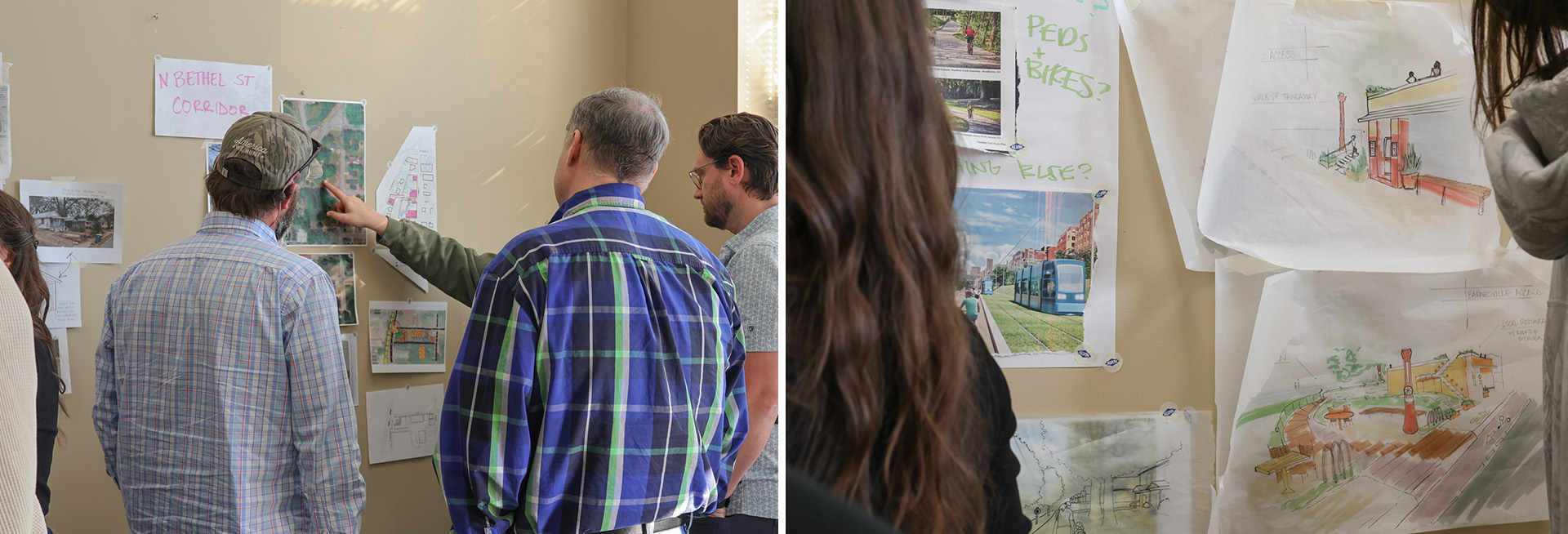
City and county officials observe concepts presented by MHP student Erika Wesch and MLA student Travis Johnson (left). A close-up of concepts presented at the final presentations to city-county officials (right).
Winding Down
Just as fast as it had arrived, the whirlwind weekend of design had come to an end. It was time to pack up the make-shift studio and return to Athens on Monday night.
In the van ride back to campus, students reflected on the value of the work they were able to contribute in just one weekend.
“Community engagement doesn’t always mean asking questions and getting answers you can work from,” said MHP student McKenna White. “Sometimes you also have to drive through a community and meet with multiple different groups to understand the challenges they might face.”
For East Thomaston, the work is just beginning.
“It was an honor to partner on such a meaningful project launch for East Thomaston,” said Lewis. “This design charrette exemplified the work I find most inspiring – celebrating cultural heritage, elevating marginalized voices, learning from small town successes, and inspiring the next generation of community practitioners. My students and I are changed by working with local leaders here, who foster a spirit of hope and collaboration into real change.”
Want to learn more about the Center for Community Design and Preservation and view past charrettes? See more at https://ced.uga.edu/outreach/.


