

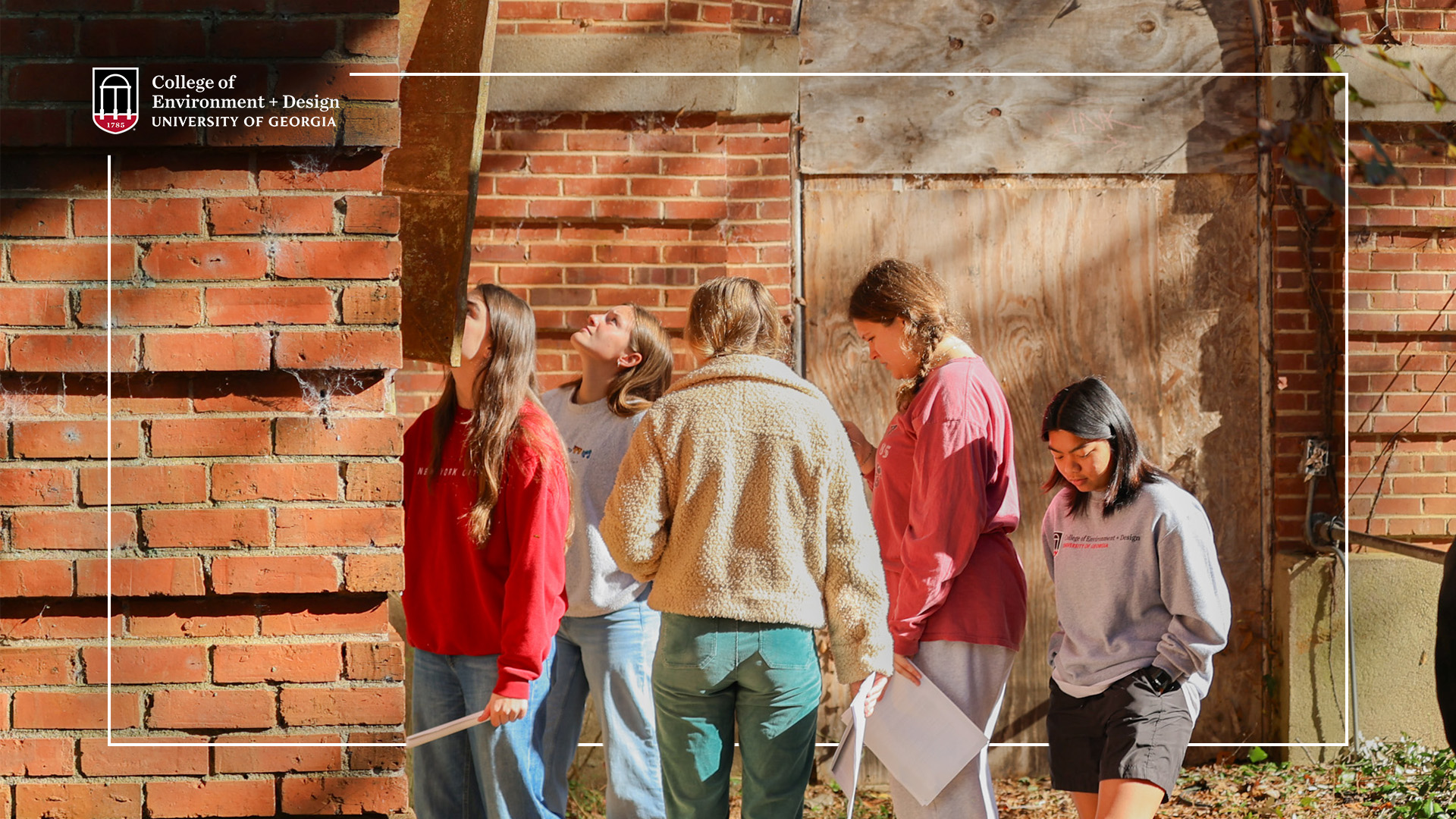
For their final project of the semester, students in associate professor Jose Buitrago’s planting design studio designed new uses for the Sandy Creek Pumping Station, an abandoned water pumping station on the North Oconee River Greenway Trail. Built by Athens civil engineer J.W. Barnett in 1916, the historic station is a relic of Athens’ industrial past.
On a cool, golden November morning, a group of 15 students shuffle down the North Oconee River Greenway Trail. As a small brick building, nearly obscured by vibrant foliage, comes into view, one by one they peel off the Greenway.

The exterior of the Sandy Creek Water Pump Station.
Tucked away in the Sandy Creek Nature Center, the Sandy Creek Pumping Station is an architectural relic of Athens’ past. This fall, the long-abandoned station was the final project for College of Environment and Design Associate Professor Jose Buitrago’s planting design service-learning studio.
Built by prominent Athens civil engineer J.W. Barnett in 1916, the station provided reservoir water to the growing city of Athens for decades before falling into disuse after the creation of a larger water treatment facility. Until the construction of the Greenway, the site remained inaccessible and neglected, and in 2020 was placed on Historic Athens’ Places in Peril List. Historic Athens is a local non-profit working to conserve community heritage in Athens.
“You’re at the juxtaposition, the transfer from nature to urbanization, at the [pump station],” said Daniel Epting, a fourth-generation Athens native, business owner and the studio’s client for the project. “What one million gallons [of water] in 1916 did for this city– economic growth, tourism– all those things build because of infrastructure. And the [pump station] is an incredible piece of infrastructure history for our county.”
Epting and representatives from Historic Athens joined Buitrago’s class for a site visit to the pump station on Nov. 3. They offered students a vision for site reuse, including a desire to give the structure a functional use and to develop the grounds around the pump station as an accessible community space, all while keeping the building eligible for the National Register of Historic Places.
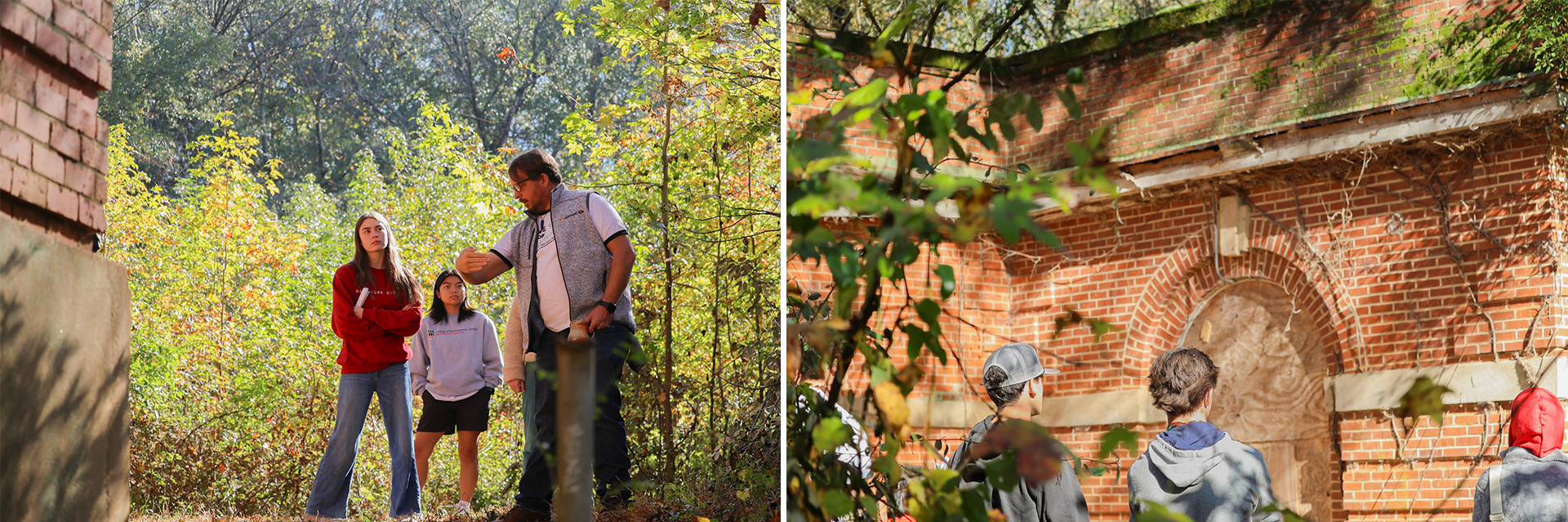
Native Athenian Daniel Epting articulates his vision for the pump station to students at the site visit on Nov. 3 (left). Students observe the pump station (right).
To keep the pump station eligible, the plan could not physically alter the original design of the station in a significant way. Although the interior of the station is boarded up, students were able to explore the exterior of the building, including the original brick and arched windows, and the surrounding landscape, which is densely forested and runs alongside Sandy Creek.
“How is this a benefit?” said Epting on brainstorming a use for the site. “How do we make sure more people have access in a beneficial way?”
In their final site design, students were instructed to design the landscape using native Georgia plants and incorporating Epting’s ideas. With a plethora of ideas to work with, students set off to finish their designs before presenting at CED’s Critique Week on Dec. 5. Epting’s brother, Ashley Epting, and three representatives from Historic Athens attended the Dec. 5 critique.
“Hopefully the visuals will serve to illustrate the potential to turn the site into a feature along the North Oconee River Greenway as well as connecting the site into the Sandy Creek Nature Center and other educational organizations within the county,” said Buitrago.
Universal design was at the heart of the project for BLA student Stella Feagle’s group. Their project, “Harmony: Reviving Roots, Renewing Flow,” features wide paths, smooth grade transitions, wheelchair accessible garden beds and an interactive water wheel.
“When designing the site, I wanted to make sure that accessibility was not just an add on, but rather universal design was at the root of the space,” said Feagle. “Because this is a historic site with a deep connection to water, the objective was to have the design function like a river, where everything is clear intuitive and supportive of who moves through it creating ‘flow.’”
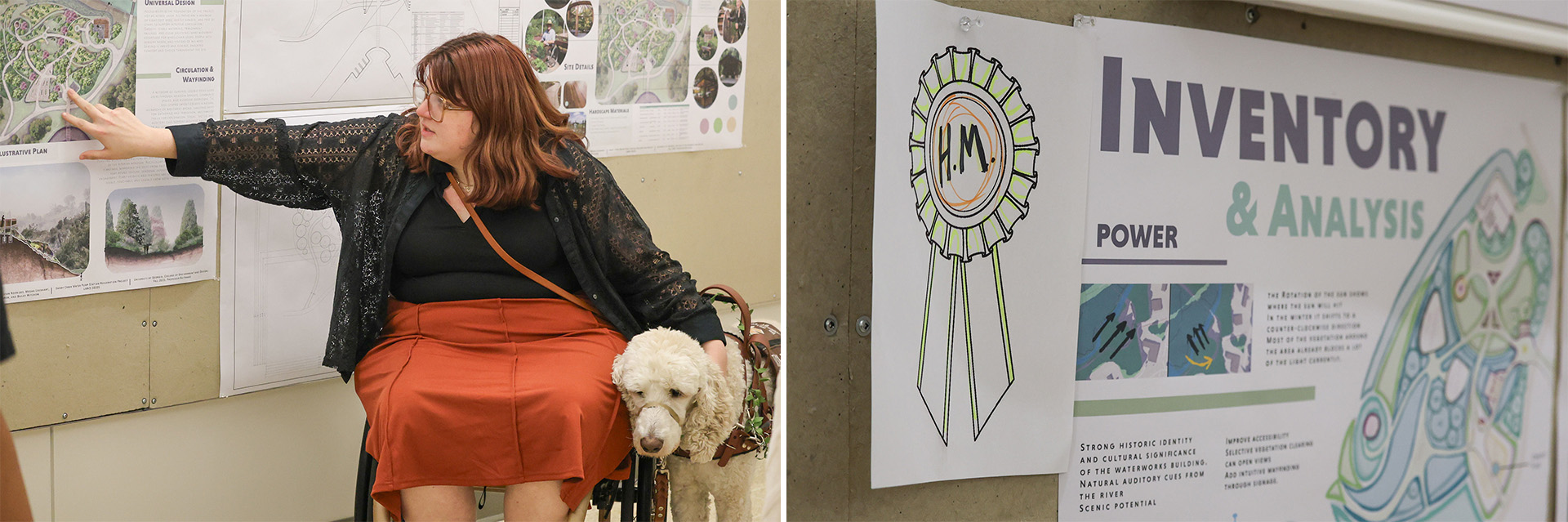
BLA student Stella Feagle presents her group’s final design for the pump station (left). Her group’s design, “Harmony: Reviving Roots, Renewing Flow” received an honorable mention from the guest reviewers (right).
Projects from other groups featured design elements like dog parks, decks to access Sandy Creek, local art installations and snack-shack style uses for the statopm. While there are no current plans by the city to restore the site, Historic Athens and Athens Clarke County Unified Government have expressed interest in site reuse. As part of the service-learning course, students were able to see how their design services can support non-profits and organizations who may not have the means to hire a landscape architect.
“Critique Week was a great opportunity to have real stakeholders and guests come and speak to us and see our project presentations,” said Feagle. “It really mirrors what it’ll be like when we have clients.”
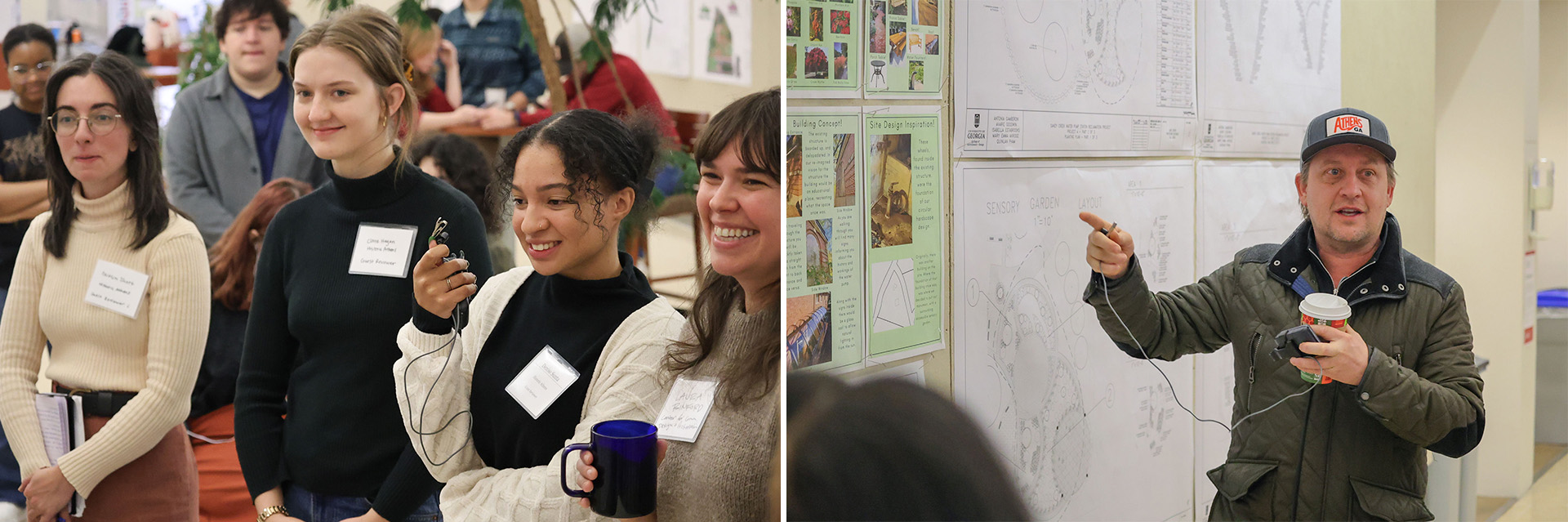
Historic Athens representatives Caitlin Short, Claire Hagan, Denise Sunta and MLA student Laura Binford give feedback during presentations (left). Ashley Epting gives feedback during Critique Week (right).
At the end of the critique, Ashley encouraged students to send their site designs to the ACC Unified Government to demonstrate the site’s potential.
“You never know when one introduction will lead to something else,” said Ashley.


